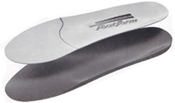
Hello Randall,
I want you to know I think of you every morning, as I slip on my shoes for the day. Since I got my orthotics in May, I have been able to work, live and play pain free! I feel like it's not an understatement when I say your work has changed my life. I have even taken up activities that years ago I thought I would never be able to do. I'm even getting ready to run a 5k this fall (just writing this is bringing tears to my eyes)!
Thank you Randall. I'm a big fan!
Lisa
______________________________________________________________
Thanks Lisa for your note. Over the many years I've been in the Orthotics business I'm always touched to hear from a happy client. The proper integration of orthotics and shoes along with the client's efforts to change stance and gait can make a positive life-changing difference to our orthotics clients.
You are obviously implementing the changes we discussed during our appointment as well as regularly wearing your orthotics and proper footwear. I'm so pleased to hear that you are experiencing good results.
Good luck in your renewed running practice,
Randall
Showing posts with label gait training. Show all posts
Showing posts with label gait training. Show all posts
Saturday, October 17, 2009


Tuesday, September 29, 2009
Good Posture is More than Standing Up Straight
 There is a lot more to good posture than standing up straight. Your default posture (how you stand, sit and move without thinking) is your basic posture. People think you're born with posture or somehow inherit it. The truth about posture is that it is a learned skill.
Our stone age ancestors had to rely on instant athletic movement to save their lives. In order to cover long distances, hunt or avoid being hunted, an athletic body was a necessity. As human kind became more civilized, ideas about movement and culture got in the way of natural movement. For example in the modern United States, fashion models and store manikins are often posed purposely in awkward positions that many young girls emulate.
Also in the U.S. many people do not move their hips while walking. I'm not exactly sure why that is. I've been observing gait for decades and find that many Americans use their hips as a hinge joint rather than the ball-and-socket joint it is, a cultural habit that I think is linked to hip damage in middle-aged adults, particularly athletes that have put many miles on their bodies.
Correct or "good" posture isn't a ramrod straight spine. Good posture is when you can move freely and easily to do anything you need to do instantly. Bad posture is when you lock your joints to brace your skeleton against itself to stay up. This locks out movement and makes any new movement a process of awkward adjustments.
Locking your knees, jutting your neck forwards or slumping your shoulders forwards are all common things people do to "rest" themselves while standing or sitting. Here are some posture tips to get you on the road to healthy posture.
- The first step to better posture is to develop body awareness through dance, exercise, yoga, martial arts, tai chi, sports -- anything that requires you to learn new movements (therefore becoming conscious of how you move).
- Now, take that new body knowledge and as much as possible stop yourself during the day and note how you are doing.
- Most importantly, bend your knees whenever you stand or walk. Never lock your knees no matter how fast you are walking.
- Keep your abs or core toned and engaged. Think about this when walking and sitting.
There is much more to say about gait and posture, but this is a good start. For personal gait and stance and posture training, contact my office for a half-hour appointment.
Footform Performance Orthotics Center, 345 SW Century Drive, Ste.1, Bend, Oregon
541-389-4547
www.Footform.com
Tuesday, May 12, 2009
Balance Everyday with Easy 1 Minute Exercise
Tipping over is a problem as we age. Toddlers tip over often as they walk, getting better and better at not falling as they practice. Most of us go through life on the walking and standing skills we developed as a child. We don't realize that balance is a learned skill, something we have to practice and nurture. If we don't practice our balance skills, as we age tipping over may start to happen again. Only with age, the consequences of falling can be dire.
Balance requires always moving to find balance. It's a subtle thing. Even though a person may appear to be perfectly still as they stand, muscles and nerves are constantly working to maintain equilibrium. Staying centered takes awareness.
Practice your balance skills with these easy tips: This exercise can take as little as 10 seconds. Repeat the exercise throughout your day.
- Keep Moving: Practice bending your knees different amounts while you walk and stand.
- While standing, practice shifting your weight in this order:(Both feet hip width apart, pointing straight ahead)
- Toe - Heel - Back to Center
- Shift Right - Shift Left - Back to Center
- Roll to the Outside of the Foot - Roll to the Inside of the Foot - Back to Center
Thursday, October 16, 2008
Using Gait Analysis to Spot Terrorists
The scientists at JPL (NASA's Jet Propulsion Lab in Pasadena, California) have taken gait analysis to a new high. So high, that scientist Adrian Stoica says it should be possible to identify a person (from a satellite) by the shapes and patterns their shadow makes as they walk across the earth. At least, this is what New Scientist Tech reported in their article, Shadow Analysis could Spot Terrorists by their Walk, Sept. 4, 2008. Stoica claims that satellite and aerial footage could be analyzed to extract the useful gait data necessary to catch a terrorist from the sky.
Yes, it's true that a person can be identified (more or less) by his gait, though it's not a fingerprint, more of a generalization. But the problem is with the premise behind this effort that says people cannot easily disguise their gait. People can change their gait. Everyday at my Footform Performance clinic in Bend, Oregon, we train people to change their gait.
Yes, it's true that a person can be identified (more or less) by his gait, though it's not a fingerprint, more of a generalization. But the problem is with the premise behind this effort that says people cannot easily disguise their gait. People can change their gait. Everyday at my Footform Performance clinic in Bend, Oregon, we train people to change their gait.
Besides, this idea of satellite gait analysis seems like a really dumb idea that costs a lot of money. Every actor in a play or movie changes their gait to match their idea of the character they are playing. What happens if the person being looked for takes off his hat? Or puts one on? Maybe he'll wear a speedo one day and a raincoat the next. What happens if he opens an umbrella or walks over a pile of rocks? Gait Analysis from space is an unnecessary expenditure of brainpower and money.
Set an appointment at Footform for gait training and gait analysis and you'll walk back and forth in front of and alongside a mirror as I coach you. No shadows and satellites. Just down to earth gait analysis. You'll feel better for only a fraction of the cost of an aerial photo.
www.Footform.com
Set an appointment at Footform for gait training and gait analysis and you'll walk back and forth in front of and alongside a mirror as I coach you. No shadows and satellites. Just down to earth gait analysis. You'll feel better for only a fraction of the cost of an aerial photo.
www.Footform.com
call for your appointment 541-389-4547
Thursday, October 9, 2008
Repetitive Strain Means its Time for a Change
I used to watch the Canadian TV comedy program, The Red Green Show (when my local Oregon Public Broadcasting OPB carried it). They often ended the show with a group of roughneck guys in the Possum Lodge repeating their credo, "I'm a man, but I can change, if I have to, I guess."
To many people, change is a concept they resist. Repetitive strain injuries, such as plantar fasciitis, shin splints, etc., are small injuries that are repeated until they become chronic. Keep doing the same thing and the injury only gets worse. The solution is to change your gait and stance habits. Albert Einstein is reported to have said, "The definition of insanity is to doing the same thing over and over and expecting different results."
Here's the list of things you can do to eliminate repetitive strain by changing your habits:
- Accept that you have to change.
- Obtain the information/education that offers you an alternative to your usual habit.
- Seek out training aids such as orthotics.
- Think of a slogan or mantra to repeat to yourself as a reminder. My favorite reminder is, "Feet straight, bend the knees."
- Visualize proper form. Picture in your mind someone who's moving the way you would like to move and emulate that vision whenever you think about it.
- Affirm to yourself that you are improving. My favorite mantra is, "I'm getting better and better."
Change takes time. Don't be too hard on yourself or expect to much too soon. Positive change happens daily, one step at a time.
Read more of my Gait Training articles on this blog.
Thursday, October 2, 2008
Walk with Gravity (But Remember to Smile!)
Gravity is the relentless force that you feel as weight on your feet. Good thing, because we'd all be flying off into space without gravity. So what is so important about remembering the basic law of gravity?
There are 2 ways to think about gravity as it relates to your gait. You work with gravity or you fight it.
- When you fight gravity your gait is mostly up on your toes (or forefoot).
- Work with gravity by bending your ankles and sinking into the ground (exagerate ankle bend so that your entire foot is on the ground).
Here's a test you can do to find out how you're working with gravity.
- Stand with your knees and ankles slightly flexed.
- Now bounce gently.
If your first movement is up -- you're bouncing on your toes and tend to be working against gravity. (And developing strains and pains in your body.)
If your first movement is to slightly bend your knees and go down before you go up, you are working with gravity. Good for you!
Bouncing "up" mostly on your toes doesn't use your entire foot and places strain on your toes and forefoot. You'll tend to lean forwards to move with each step. The result is strain and eventually pain.
Bending your knees and ankles has the opposite effect. Your balance becomes grounded, steady and secure. You expend less energy and are stable.
So what do you do when you walk so that you are working with gravity? Keep your feet straight and bend your knees and ankles as you walk. Exaggerate the movement when you first practice this. Integrate knee and ankle bend into every step of your day and you'll find your balance and muscle tone improving and minor aches and pains related to walking will diminish. Less pain and more strength is surely a reason to smile.
Monday, June 2, 2008
How to Walk Like a Very Old Person
Of course you don't really want to walk like an old person. What may surprise you is that the impression of age starts long before you get close enough to a person to see a wrinkle. A person's gait and posture conveys their strength, balance, and flexibility.
Walking is propulsion. As toddlers we all start with a stiff-legged stance and leaning forwards to create motion. I call this "The Leaning Tower Stride". Once you're past the age of three, this stride will only make you look old.
I see variations of the Leaning Tower Stride constantly in my Footform Performance clinic in Bend, Oregon. This stride uses fewer joints: the hip and toe (metatarsal) joints -- therefore a person with a injury or ache may default to this style of movement. The hip is used as a hinge joint instead of as a ball and socket. The forward momentum of the stride is created by jutting the neck and shoulders forward. This brings the top of the body in front of the feet creating a "fall" where each leg "catches up" with the rest of the body.
The result of this bio-mechanical movement is that the body is on the edge of losing balance constantly and the hip and toe joints get undue stress. All sorts of problems come with too much stress on joints.
The solution is a balanced stride. The body is in an athletic position with the knees slightly bent. Pretend you are receiving a tennis serve or flexing before a golf swing. As you go through your daily activity here are the things to keep in mind for healthy movement:
www.Footform.com 541-389-4547
Walking is propulsion. As toddlers we all start with a stiff-legged stance and leaning forwards to create motion. I call this "The Leaning Tower Stride". Once you're past the age of three, this stride will only make you look old.
I see variations of the Leaning Tower Stride constantly in my Footform Performance clinic in Bend, Oregon. This stride uses fewer joints: the hip and toe (metatarsal) joints -- therefore a person with a injury or ache may default to this style of movement. The hip is used as a hinge joint instead of as a ball and socket. The forward momentum of the stride is created by jutting the neck and shoulders forward. This brings the top of the body in front of the feet creating a "fall" where each leg "catches up" with the rest of the body.
The result of this bio-mechanical movement is that the body is on the edge of losing balance constantly and the hip and toe joints get undue stress. All sorts of problems come with too much stress on joints.
The solution is a balanced stride. The body is in an athletic position with the knees slightly bent. Pretend you are receiving a tennis serve or flexing before a golf swing. As you go through your daily activity here are the things to keep in mind for healthy movement:
- Bend your knees and point your feet straight ahead as you walk.
- Focus on the back foot in the stride staying on the ground as long as possible and pushing you off from behind.
- Do a few practice hula dance movements to loosen the hips.
- Keep your abs toned (Keep your stomach muscles firm, pulling inwards towards the spine.)
- Wobble your head and shoulders loosely to feel the center of the joints. (This takes practice - a mirror and a coach helps here).
www.Footform.com 541-389-4547
Tuesday, April 29, 2008
Knee Pain Isn't Inevitable
Knee pain isn't inevitable as you age. Barring injury, how you use your knee with each step determines how wear and tear of use affects your body. The knee is a hinge joint designed to bend in a straight line. Knee strains and pains occur when the arc of the bend becomes twisted. The beginning of a twist starts with the foot pronating (or rolling inwards on the big toe side). Twisting the foot results in twisting the ankle which carries the stress to the knee. The knee will rotate inward. Repeating this movement throughout the 10,000 steps you take in a day can result in a repetitive strain injury.
If you're sedentary you take less than 10,000 steps per day. If you have a job that requires walking like a nurse or postal worker you'll be taking even more steps.
So what can you do to protect your knee as you walk?
www.Footform.com
If you're sedentary you take less than 10,000 steps per day. If you have a job that requires walking like a nurse or postal worker you'll be taking even more steps.
So what can you do to protect your knee as you walk?
- Bend your knees slightly (keep a soft knee) with every step and while you stand.
- When you're walking, concentrate on keeping your heel on the ground as long as possible (this discourages toe walking).
- When you walk, concentrate on keeping your foot pointing straight ahead with every step and keeping the direction of your knee bend straight over the foot.
- Keep your hips loose and rotating with each step.
- Look for shoes that are stable such as an athletic shoe or walking shoe that bend easily in the forefoot.
- Foot Orthotics help to guide your foot so that it doesn't pronate.
www.Footform.com
Tuesday, April 8, 2008
Hip How-To: Learn to Walk Well From Your Hips
Bio-mechanics is the science that explains how the structures of the body function mechanically. Each joint in your body has a design that moves optimally certain ways. The joint may also allow types of movement that the joint is not best designed to handle.
For example, your elbows and knees are hinge-joints. They bend back and forth in the same direction. They don't allow much rotational movement. If you do over-rotate those joints you'll often incur a sprain or more severe injury.
The hip joint is different from the knee in that it is a ball and socket joint that allows your hips to move both rotationally and as a hinge joint. Here's what you need to know: Your hips are designed to move best as a rotational joint. If you walk, hike or run and don't rotate your hips adequately, your hips move like a hinge joint. Too much of this type of movement in the hip joint causes over-use injuries/damage.
To practice what a rotational movement of the hip feels like, do the Hula. Really!
www.Footform.com
For example, your elbows and knees are hinge-joints. They bend back and forth in the same direction. They don't allow much rotational movement. If you do over-rotate those joints you'll often incur a sprain or more severe injury.
The hip joint is different from the knee in that it is a ball and socket joint that allows your hips to move both rotationally and as a hinge joint. Here's what you need to know: Your hips are designed to move best as a rotational joint. If you walk, hike or run and don't rotate your hips adequately, your hips move like a hinge joint. Too much of this type of movement in the hip joint causes over-use injuries/damage.
To practice what a rotational movement of the hip feels like, do the Hula. Really!
- Stand with feet shoulder width apart and knees gently bent.
- Rotate your hips in circles, first clockwise, then reverse directions.
- Now, walk backwards slowly and notice how the hips automatically rotate, taking the leg back.
- Slowly walk forwards, seeking to maintain the sensation of hip movement. Remember to keep your knees slightly bent.
www.Footform.com
Thursday, March 27, 2008
Gait Analysis: How Well are You Walking?
Watch a person walk down the street. Even from a distance you are making unconscious assumptions about their age, athleticism, and self confidence.
There are two main styles of walking:
There are two main styles of walking:
- The Leaning Tower: When a person leans forward and puts out a foot to catch themselves as they walk. They are using gravity to keep moving. Typically, when a person walks this way, their leg is straight and their hip joints are stiff, because their hip joint is being used like a hinge joint (like the knee) rather than as a ball and socket. The focus of the stride is on the beginning of the step. This is linked to hip problems, knee problems and lower back pain.
- The Balanced Stride: When a person has a upright (centered) position over the stride. The knees are flexed (very slightly bent), the ankles bend, the hips (and core of the body) rotate with each step. The focus of the stride is on the finish of the step. Each joint is moving as it should, pain and future (or past) problems are minimized.
Subscribe to:
Posts (Atom)


 Posts
Posts