Showing posts with label plantar fasciitis. Show all posts

Friday, October 31, 2008

Fallen Arches - Fact or Fallacy?

Is there such a thing as "fallen arches"? Usually when people say they have flat feet or fallen arches, they have flexible feet, though there are exceptions.

The plantar fascia band on the bottom of the foot is similar to the bow-string of an archery bow. Over many years the plantar fascia band may gain length. Partially this is true because of bony growth called a heel or bone spur.

Another result of this fascia lengthening is that people think their feet are growing longer, but they didn't "grow". With the loosening plantar fascia band the foot elongates or spreads out. This is especially common if a person has put on a lot of weight. 

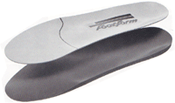
Oddly enough, the most flattening of the foot occurs on hard flat man surfaces. If you step in sand or soft earth, even a flexible foot is firmer than the ground, so instead of the foot giving to the ground, the ground gives-in to the foot. This is why Footform custom orthotics mimic the natural footprint in sand, so that the foot remains in a natural state while weight-bearing.

Thursday, October 9, 2008

Repetitive Strain Means its Time for a Change

 I used to watch the Canadian TV comedy program, The Red Green Show (when my local Oregon Public Broadcasting OPB carried it). They often ended the show with a group of roughneck guys in the Possum Lodge repeating their credo, "I'm a man, but I can change, if I have to, I guess."

To many people, change is a concept they resist. Repetitive strain injuries, such as plantar fasciitis, shin splints, etc., are small injuries that are repeated until they become chronic. Keep doing the same thing and the injury only gets worse. The solution is to change your gait and stance habits. Albert Einstein is reported to have said, "The definition of insanity is to doing the same thing over and over and expecting different results."

Here's the list of things you can do to eliminate repetitive strain by changing your habits:
  • Accept that you have to change.
  • Obtain the information/education that offers you an alternative to your usual habit.
  • Seek out training aids such as orthotics.
  • Think of a slogan or mantra to repeat to yourself as a reminder. My favorite reminder is, "Feet straight, bend the knees."
  • Visualize proper form. Picture in your mind someone who's moving the way you would like to move and emulate that vision whenever you think about it.
  • Affirm to yourself that you are improving. My favorite mantra is, "I'm getting better and better."

Change takes time. Don't be too hard on yourself or expect to much too soon. Positive change happens daily, one step at a time.

Read more of my Gait Training articles on this blog.

Monday, April 14, 2008

Plantar Fasciitis Heel Pain

The most common repetitive strain injury I see in my clinic is Plantar Fasciitis. The symptom that indicates a possible diagnosis of Plantar Fasciitis is pain in the heel on the bottom of the foot especially when taking the few first steps in the morning or after resting. Micro tears and resultant inflammation in the tissue at the connection point between the plantar fascia and heel bone are responsible for the pain. Resting at night, the plantar fascia repairs a little bit, then tears again in the morning with those first steps.

Most of us take 10,000 steps per day. Those steps constantly irritate the plantar fascia. The plantar fascia is part tendon and part soft tissue, the only structure like this in the body.

Though the pain of Plantar Fasciitis is felt in the heel, putting weight on the heel (or a strong heel strike) is not the cause of Plantar Fasciitis. Mistakenly, most people treat the problem with heel cushions. Though a person may feel relief with heel cushions, the true problem won't be addressed. The usual gait compensation is to walk on the toes. This causes a shortening of the calf muscles and more toe walking, creating a vicious cycle, resulting in chronic cases of plantar fasciitis. I've seen people in my clinic that have had chronic plantar fasciitis for years.

The true problem is a strain on the entire plantar fascia along the bottom of the foot. To reduce the strain, it's important to keep the heel down during the stride and to let the entire foot linger on the ground with every step, rather than walking primarily on the forefoot and toes.

Full foot orthotics and proper shoes along with gait and stance training will alleviate the strains that caused the Plantar Fasciitis. With the proper care and attention to gait, most cases improve dramatically in 6 weeks.

If you keep doing the same thing over and over, ten-thousand steps a day you will get the same result. Step by step, changing the habits you've developed in your stride, along with an excellent foot orthotic will promote healing of the plantar fascia.