Showing posts with label orthotics supplies. Show all posts

Monday, July 13, 2009

Orthotics and Renewable Resources

I've been dedicated to making safe custom foot orthotics or shoe inserts for decades. In the 1990's, I was motivated to make custom orthotics that last a long time. Most off-the-shelf shoe inserts or orthotics only last a few months before the orthotics materials compress out of shape and lose their shock absorption and supportive qualities.

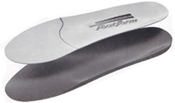
My artisan made custom orthodics have a lifespan of five to ten years if the clients foot hasn't drastically changed. I succeeded with my goal of producing very long lasting custom orthotic arch supports that absorb shock while supporting the foot and increasing foot comfort. Footform shoe inserts are ideal for treating the flat foot, plantar fasciitis and other foot problems. Inserted into a well designed shoe such as a good athletic shoe that is right for my client, a custom orthotic and athletic shoe combination may be as good as or better than available orthopedic shoes.

We sell our brand of visco-elastic polymer mixed with cork, VISCORK™. I developed these arch support orthotics materials that I package and sell through my business, Footform Labs. Visco based materials have tested superior to all other orthotic materials yet they are rare because the first-generation fabrication methods were difficult and unconventional.

There is only one known competitor to our material, which is PQ™. I developed a visco fabrication method with Footform® Mold Shells that is an extremely simple system to make custom shoe inserts. Also, it is the only known method to thermo-form Poron®. Our VISCORK™ material has many advantages: easy grinding, low odor, no hazard rating, lightweight, simple 50-50-100 mix ratio, and less expensive. Our VISCORK is a perfect modern replacement of old-fashioned rigid orthotics technology. And, cork is a renewable resource. It's a win-win for our Footform clients, us and our planet!

Orthotics Manufacturers, Podiatrists, Chiropractors, Physical Therapists and other medical professionals can order our low hazard and safe foot orthotic supplies at 541-389-4547. We formulate, mix, assemble and ship all of our custom orthotics materials from Bend, Oregon. Made in the U.S.A.

www.Footform.com


photo: Cristina Acosta

Wednesday, February 11, 2009

Our Orthotics Materials are Enviro-Safe


All of our Footform foot orthotics are artisan made in our labs. That means that not only are the technicians making the foot insoles exposed to the orthotics materials, but that any pollutants present are released into the local area.

In the old days orthotics were made out of a rigid plastic known as rohadur. Rohadur was banned due to it's harmful environmental impact. The substance also lacked shock absorbing properties. Rohadur was old and bad technology.

My Footform orthotics are made from non-toxic polyurethanes and cork (a renewable resource).

Many years ago, before it was cool (in the early 1990's) I developed my current enviro-safe orthotics materials and fabrication process. Here's why: I personally make orthotics and work with the materials, as well as supply colleagues with the visco elastic polymer orthotics supplies so that they can fabricate orthotics. It's important to me that the technicians have a safe working environment. Also, during those years, my wife and baby were in the office during much of the day, and I wanted to ensure their health.  An added plus is that my Footform orthotics last for many years (5 to 10 years) and I am confident that my clients are using a safe product.  

If you're looking for a safe and effective orthotics material, contact me and I will talk with you about my orthotics materials and supplies. I named the product Viscork (TM), and it is packaged for distribution.  

Randall Barna 541-389-4547

Wednesday, April 23, 2008

Ask Randall: Generic Insoles

April 16, 2008 11:45 AM

Hi Randall, I was wondering if you can tell what elements are needed for a generic insole that would bring comfort to a shoe wearer. What material would you use? By the way your blog is amazingly full of facts and I am enjoying reading each post. SA

Dear SA,

In the shoe industry, the term generic insoles refers to what's also called a sock liner, contoured insole, or generic orthotic.
  • Sock liners are generally a flat cushion layer, sometimes removable, but usually glued into the shoe.
  • Contoured insoles are formed from molded foam to fit the shoes interior and cup the the mid-foot and heel around the edges. Generally this insole has little to no anatomy.
  • Generic orthotics are formed from molded foam or/and other materials. It is like a contoured insole, but has actual arch contour and more anatomy.
Here's what I think are the best choices in each category:
  • Sock Liners: Multi-density foam layers. One layer that forms to the foot layered over one resilient layer that springs back to the original shape.
  • Contoured Insoles: The same as a multi-density sock liner, but with the upper layer being a molded foam shape.
  • Generic orthotics: Typically an after-market product, sometimes they are actually built into a shoe such as a Birkenstock. The most important thing is that the contour doesn't offend the user's foot contour.
The object to orthotic contours is to guide the foot to it's optimal use. The closer the contours are to the foots natural contours, the higher the performance of the orthotic. Peoples feet are different, therefore a mass market product will only address one type of foot over another.

The optimal high performance is a custom orthotic. Because this option isn't available to everyone, the next best thing is to try on a multitude of generic orthotics to seek a good match.

Note: I offer consulting to manufacturers and designers seeking information about foot contours, orthotic shapes and materials. In the past I've patented two systems relating to this research.

Monday, March 31, 2008

What is Your Orthotic Made Of? Viscork is our Choice

When I first began researching custom orthotic materials, I was looking for flexibility, durability and shock absorption. Though I was doing this research in the early 1990's (and the environment was not as trendy then), I felt that my materials should also be as environmentally safe as possible and result in a custom orthotic that would last a long time (rather than being "disposable").

I realized that foam and hard plastic or other reinforced rigid materials don't have the range of properties clients need in a custom orthotic. Those materials lose their shapes soon or sacrifice one quality for all others. Over-the-counter orthotics made of foam rarely outlast the life of a shoe. The foam compresses and looses it shape and shock absorption. Clinicians may try to remedy the faults of various orthotics materials by gluing a variety of products together, hoping for the best. It is an ineffective compromise at best.

Through years of research, trial and error I developed a material I sell called Viscork. Viscork orthotic material is a visco elastic polymer. Viscork is a unique combination of visco elastic polymer with cork granules. Cork is a renewable resource. Properties of Viscork replicate as closely as possible the natural protective tissues of the foot. Viscork absorbs shock and permanently maintains it's shape, therefore ensuring support for years. Clients often use their Viscork orthotics upwards of 5 to 7 years, longer than most people own their cars!

All of the orthotics we make at Footform Performance Labs are made using Viscork orthotics materials. If you represent a orthotics lab, contact us to buy Viscork for your custom orthotics production.
www.Footform.com