Thursday, January 22, 2009

Keep Your Balance on Your Feet and In Your Life

Having good balance keeps you from falling down. And I'm not only talking about tripping and falling. Balance goes beyond your feet and relates to your life. A commitment to balance in all things helps with your life. Balance is all about movement, continually finding that sweet-spot between two extremes.

Here's an example: Imagine a teeter-totter or see-saw, the children's toy in many playgrounds. If one side is over-loaded the teeter-totter gets stuck on one side and movement stops. The eventual outcome of less movement for the human body is a sedentary life that can result in a wheelchair. 

Physical skills for balance: (Here are the 2 main skills most of us have.)
  • Feel for the ground: Sensing your foot you are aware of where the pressures of your weight is on your foot. The more foot you have on the ground, the more stable you are in most cases. Experiment with movement heel-to-toe and inner-to-outer side of your foot, especially when walking.
  • Vision: Most people rely on their vision for balance. When vision tilts the body corrects. Try closing your eyes and walking around (in a safe place) to see how much you rely on your vision.
  • Inner Ear: Not under our control.
Our goal is to use both visual skills and your feel for the ground. Here are some tips to improve your balance:
  • Walk backwards: Your feel for the ground is enhanced because you can't see where you're going.
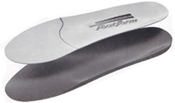
  • Orthotics: The point of a foot orthotic is to increase your feel for the ground (not just cushion your foot). The exact 3-D matching contour between orthotic and foot helps you sense any movements and to make adjustments so that you keep your balance.

Tuesday, December 9, 2008

Flat Feet, High Arches or Pronating, What is Your Foot Type?

Most of my clients are surprised to learn that there are generally 9 factors that determine a person's foot type. I say generally, because there are always exceptions to any organizing system. As a Certified Pedorthist of almost 2 decades and fitting technical athletic footwear since 1970, I've seen many different types of feet. I've developed this list to categorize feet so that I can most quickly identify a orthotic client's concerns and help them. Here are the 9 factors:

Foot Physiology:
  • Low Arch foot with Flexible Joints (sometimes referred to as a flat foot)
  • High Arch foot with Stiff Joints
  • Neutral Arch foot with Moderate Joint Movement
Foot Shape:
  • Oblique Toe (Big toe is longer and foot tapers angularly to the small toes).
  • Square Toe (Little toes are exceptionally long and big toe is short - The toes are close to the same length).
  • Round Toe (Second toe extends longer than the big toe).
Volume: How thick or thin your feet are. Including how much tissue the foot has and how big the bones are of the foot.
  • Low volume (Foot could be wide or narrow, but there isn't much bulk to the foot.)
  • Mid Volume (Foot is well proportioned.)
  • High Volume (Foot is thick, bulky, large boned)
The reason it is important to know that there are nine classifications of feet is to identify the key characteristics of your foot type so that you can focus on comfort footwear or sports performance features that best suit your foot type.

Often a person will choose a shoe based on looks or the advice of a friend, and not really have any idea if the shoe properly fits their foot. As you can see from the list of foot characteristics, there are many variables involved with shoe fitting and depending upon the type of foot you have, you may not easily find the best shoe for your foot without some professional advice.

At Footform Performance Center in Bend, Oregon, we analyze feet, mold and make custom foot orthotics (shoe inserts), then fit the orthotics into the client's footwear. Part of our orthodics service includes shoe consultation and recommendations. Footform custom shoe inserts increase foot comfort and sports performance. I am also available to consult to the shoe industry to create footwear that is designed for the widest variety of foot types.

Call or contact Footform Performance Center, 541-389-4547, 345 SW Century Dr., Bend, OR
Randall@Footform.com

Wednesday, December 3, 2008

Why are Custom Orthotics Better for You than Off the Shelf Footbeds

Clients will sometimes ask me what the difference is between prefabricated foot orthotics and custom foot orthotics, even sometimes claiming that both orthotics feel the same. Though there is that rare person that has the exact foot match to a generic orthotic contour, usually a person is responding to the cushion of the foot orthotic, a trait that doesn't have a lot to do with performance of the footbed.

Just to look a prefab foot orthotic is impressive. Mass production techniques often result in a snazzy looking foot orthotic  (also called a insole or footbed). Despite the appearance and marketing, a pre-made foot orthotic is generic. The cushiony feel of most pre-fab insoles helps to cover up the lack of a perfect fit.

What really counts when you buy a foot orthotic is the arch contour and how the orthotic fits into the shoe. A foot orthotic you put in your shoe is there to optimally guide your foot so that you can make changes and adjustments in your foot position.

A pre-fab orthotic or insole is low-performance (despite the appearance) because since the contours of the orthotic are generic, you won't notice that your foot is out of position until the movement is obvious. 

A custom made foot orthotic is high-performance because of the exact fit with the contours of your foot. Every move your feet make, you can feel. This is important, because when your foot is moving well, fatigue, over-use and injuries are reduced.

The next step to a successful application of an orthotic is to fit it into a shoe. This requires cutting and grinding skills that fit the foot orthotic into the existing contours of your shoe. It also requires that you are wearing the best shoes for you feet. My next post will be about foot types and shoes.

When you buy a custom foot orthotic you should buy them from a trained technician who can tell you about the optimal use of your foot. They'll educate you about the types of shoes you should wear for your foot type and also fit the orthotic into the shoe. They will give you stance and gait training so that you can get the best out of your foot orthotic.

At Footform Performance Center  we give you that kind of orthotic, shoe and gait training service. Your foot orthotics will both be effective and last for years (rather than most pre-made foot orthotics that compress out of shape within months then live forever in the landfill).

Call or contact Footform Performance in Bend, Oregon for an appointment. 541-389-4547

Wednesday, November 19, 2008

Custom Ski Boot Fitting

Fun and pain don't go together if you want to excel in sports. Of all of the sport footwear that can really hurt your feet, ski boots are at the top list. Finding a solution to alleviate painful ski boots takes an experienced technician. Custom ski boot fitting is the solution.

In 1966 I was a Certified Ski Technician in Bend, Oregon. I went on to manage, then own a ski shop and spent decades in the ski business before I became a Board Certified Pedorthist. It was a long time ago, and I've learned a lot since then, following snow sports of all types through their life cycles.

During most of the 20th Century, Alpine Downhill skiing was the dominant snow sport. By the 1990's diversity was the trend and now people are on the snow in a variety of ski boots. Custom fitting snow-sport boots is my favorite specialty.

My custom snow sport and custom ski boot fitting service at Footform Orthotics Center in Bend, Oregon is: (We do this process quickly and efficiently because we charge by the hour.)
  1. Analyze the boot fitting problem during the appointment which includes a full professional foot exam.
  2. Isolate the fit problem determining the footwear compatibility with the foot.
  3. Perform alterations.
  4. Ski Boot Canting - Check for cant angles and alignment.
  5. After the custom shoe or boot alterations are done, the client tries the ski boot, skate boot or snowboard boot out on the snow.
  6. If necessary, the client returns for a short visit to get the fit tweaked.
At the Footform Performance Clinic in Bend, Oregon I custom fit the following snow riding boots: Footform custom orthotics are included in the process unless the client has an orthotic that is acceptable.
Telemark Ski Boots, AT Boots, Alpine Downhill Ski Boots, Nordic Cross Country Ski Boots, Nordic Skate Boots, Snowboard Boots.

We also sell the Daleboot for Alpine Downhill Skiing. The Daleboot can be a custom fit ski boot with custom shell modifications and thermo formed ski boot liners combined with custom ski boot foot orthotics. The Daleboot can accomodate the wide ski boot customer with alterations. My price includes my custom orthotic footbed for the ski boot. The Daleboot is the ONLY ski boot made in the U.S.A., which means that if a client has a particularly challenging fit problem, it is more likely to be solved in my office by customizing both the ski boot shell, liner and ski boot footbed. Because I work in partnership with the Daleboot factory to fit my client, true custom ski boot fitting is possible in a variety of ski boots size.

Call us at the Footform Performance Clinic 541-389-4547 to set your snow sport and custom ski boot fitting appointment. We're located at 345 SW Century Drive in Bend, Oregon. Century Drive/14th Street is the road to Mt. Bachelor ski area. Get a ski boot fit and test it on the mountain during your visit to Bend, Oregon.

Wednesday, November 5, 2008

Growing Pains: Why Kids Complain

Kids complain about pain in the back of their legs -- calf and hamstring muscles. Commonly referred to as growing pains, these twinges occur because bones grow at a much faster pace than muscles. The problem that youth (ages 10-16) have as they grow is that as soon as their muscles start getting tight during and after a growth spurt, they compensate for the muscle tightness with actions such as toe-walking and pronating. 
  • Toe-walking - not "tiptoe" walking, but a stride where the heel does not touch the ground. The pivot point in the stride is at the forefoot instead of the ankle.
  • Pronating: The mid-foot collapses inward and  gives the appearance of ankle bend, but is really stress on the foot. 
These gait compensations create strains in the tendons connecting muscles to the foot (plantar fascia and achilles tendon). Then the muscles that attach up the leg become tighter, hence a kid will experience more growing pains. Muscles need to be used, stretched and worked to grow bigger and longer. (This is true at anytime of life.)

When a youth has growing pains, here's what you do:
  • Explain to them what's going on.
  • Keep them in physically active recreation or sports that don't have a lot of sitting-around time.
  • Teach them this simple stretch: Sit on the floor with your legs straight out in front of you and your feet against a wall or piece of furniture. With your back straight, use your hands to push your torso forwards until you feel a stretch. Hold this 30 seconds. Repeat 3 times.
  • Remember: Feet straight, bend your knees (just a little) as you walk and stand.

Friday, October 31, 2008

Fallen Arches - Fact or Fallacy?

Is there such a thing as "fallen arches"? Usually when people say they have flat feet or fallen arches, they have flexible feet, though there are exceptions.

The plantar fascia band on the bottom of the foot is similar to the bow-string of an archery bow. Over many years the plantar fascia band may gain length. Partially this is true because of bony growth called a heel or bone spur.

Another result of this fascia lengthening is that people think their feet are growing longer, but they didn't "grow". With the loosening plantar fascia band the foot elongates or spreads out. This is especially common if a person has put on a lot of weight. 

Oddly enough, the most flattening of the foot occurs on hard flat man surfaces. If you step in sand or soft earth, even a flexible foot is firmer than the ground, so instead of the foot giving to the ground, the ground gives-in to the foot. This is why Footform custom orthotics mimic the natural footprint in sand, so that the foot remains in a natural state while weight-bearing.

Monday, October 20, 2008

Prevent Fractures: Tips for Better Balance

Have you ever lost your balance? Of course you have, and it's usually no big deal. But if loosing your balance results in a fall, the result can be serious. According to a recent Swedish study, impaired balance is associated with triple the risk of hip fracture! 

As we age, bones may become more brittle and the risk for fractures increases. As a person gets more sedentary and moves less in their life, they lose flexibility and balance along with other types of fitness. This can happen regardless of a person's age, and is especially important for older people. 

Balance requires mobility in motion. Have you ever balanced a yardstick or pole vertically on the palm of your hand? You'll notice that to keep the pole vertical you must move your hand around. If you hold your hand still, the pole falls off your hand.

So how does this relate to keeping your balance as you're standing "still". Well, when you stand, if you keep your knees soft (slightly bent), your pelvis/hips are free to move. Your potential for mobility is increased. If you lock your knees (keep them straight), you lose mobility, and your balance worsens. This is a subtle difference, but a difference that is very important as we age. 

The ASBMR (American Society for Bone and Mineral Research) published the article, Lack of Balance Predicts Fractures. They cited a recent medical study in Sweden, and Karl Michaelsson, M.D., P.H.D., of the Uppsala University Hospital in Uppsala Sweden. In the study, impaired balance was associated with double the risk of any fracture!

Here are some tips to improve your balance as you stand:
  • Bend your knees a little EVERY time you stand AND Walk.
  • Keep your hips loose. Visualize the Hula dance and practice bending your knees and moving your hips in circles.
  • Feel the ground with your feet. Concentrate on "sinking" your weight through your feet into the ground.
For advanced practice, do all of the above while standing on one foot. Be sure to alternate feet.

Thursday, October 16, 2008

Using Gait Analysis to Spot Terrorists

The scientists at JPL (NASA's Jet Propulsion Lab in Pasadena, California) have taken gait analysis to a new high. So high, that scientist Adrian Stoica says it should be possible to identify a person (from a satellite) by the shapes and patterns their shadow makes as they walk across the earth. At least, this is what New Scientist Tech reported in their article, Shadow Analysis could Spot Terrorists by their Walk, Sept. 4, 2008. Stoica claims that satellite and aerial footage could be analyzed to extract the useful gait data necessary to catch a terrorist from the sky.

Yes, it's true that a person can be identified (more or less) by his gait, though it's not a fingerprint, more of a generalization. But the problem is with the premise behind this effort that says people cannot easily disguise their gait. People can change their gait. Everyday at my Footform Performance clinic in Bend, Oregon, we train people to change their gait.

Besides, this idea of satellite gait analysis seems like a really dumb idea that costs a lot of money. Every actor in a play or movie changes their gait to match their idea of the character they are playing. What happens if the person being looked for takes off his hat? Or puts one on? Maybe he'll wear a speedo one day and a raincoat the next. What happens if he opens an umbrella or walks over a pile of rocks? Gait Analysis from space is an unnecessary expenditure of brainpower and money.

Set an appointment at Footform for gait training and gait analysis and you'll walk back and forth in front of and alongside a mirror as I coach you. No shadows and satellites. Just down to earth gait analysis. You'll feel better for only a fraction of the cost of an aerial photo.

www.Footform.com
call for your appointment 541-389-4547

Tuesday, October 14, 2008

The Low-down on High Fashion Heels

Six inch dress heels for women are selling. In fact, according to today's article in The Wall Street Journal, "Women Fall Head Over Heels for Shoe Makers' Arch Designs", by Teri Agins, this super-high segment of the shoe industry is selling so well that Manolo Blanik says it accounts for about 30% of his company's business.

Despite the craziness of fashion, the most disturbing thing to me was to read was that Podiatric Surgeons are injecting cosmetic fillers such as Restylane or Juvederm to plump up the balls of the feet (metatarsal area of the foot) in an effort to ease the painful pressures on the forefoot caused by these high heels.

So here's what I have to say about these sky high shoes -- Don't wear them!  Sprained ankles, artificial interventions (like injecting cosmetic fillers), and strained joints(from the gait change the shoes impose) can cause injuries that can impact your life for years.

If you want to appear tall, improve your posture. But more than that, remember that others don't see you statically, like in a photograph or the way you see yourself in front of a mirror. People perceive your age and attractiveness before they ever get close enough to see if you have a wrinkle. How you carry yourself in motion can convey confidence, athleticism, flexibility and strength.   

High heels seen in motion promote the opposite of this. High heels hobble your body's motion and athleticism. You may think you look great standing still, but do you want to be hobbled and risk injury? Hobbling is defined as strapping together the legs of an animal (such as a horse)to slow it down and prevent it from straying, or to cause a person to limp. Psychologically, hobbling yourself for the sake of fashion creates a conflict between the fashion desires of your mind and the natural health of your body.

Your body has a wisdom and intelligence that knows when it's being impaired by a terrible choice of footwear. Choose to look at fashions that hobble your movement as promoting weakness rather than strength.


Thursday, October 9, 2008

Repetitive Strain Means its Time for a Change

 I used to watch the Canadian TV comedy program, The Red Green Show (when my local Oregon Public Broadcasting OPB carried it). They often ended the show with a group of roughneck guys in the Possum Lodge repeating their credo, "I'm a man, but I can change, if I have to, I guess."

To many people, change is a concept they resist. Repetitive strain injuries, such as plantar fasciitis, shin splints, etc., are small injuries that are repeated until they become chronic. Keep doing the same thing and the injury only gets worse. The solution is to change your gait and stance habits. Albert Einstein is reported to have said, "The definition of insanity is to doing the same thing over and over and expecting different results."

Here's the list of things you can do to eliminate repetitive strain by changing your habits:
  • Accept that you have to change.
  • Obtain the information/education that offers you an alternative to your usual habit.
  • Seek out training aids such as orthotics.
  • Think of a slogan or mantra to repeat to yourself as a reminder. My favorite reminder is, "Feet straight, bend the knees."
  • Visualize proper form. Picture in your mind someone who's moving the way you would like to move and emulate that vision whenever you think about it.
  • Affirm to yourself that you are improving. My favorite mantra is, "I'm getting better and better."

Change takes time. Don't be too hard on yourself or expect to much too soon. Positive change happens daily, one step at a time.

Read more of my Gait Training articles on this blog.